Twitter Mirror
Case study: Twitter Mirror

In the early days of social media, Twitter had to figure out how to win against Facebook for major live events. We were the underdogs, so we had to do it by listening to everyone's needs and finding a solution that somehow solved everyone's problems: TV networks wanted to drive tune-in for major events; Twitter wanted to be seen as being at the center of the action; celebrities wanted to be seen backstage at the biggest events on the planet. My solution? A piece of plexiglass, an iPad, and a stripped-down build of Twitter that auto-tweeted photos.
Timeline
- 01
It started with a sketch
It started with a drawing and a hackweek project. Twitter's Media team had previously experimented with passive hidden cameras, such as a "Backboard Cam" for the NBA, but that wasn't the right feeling for events with a stage. When the media team brought me in to rethink what could be done, I realized the answer needed to be more personal, with the stars choosing to actively participate. It needed to be interactive where the celeb remained in control. In a few days, we built a stripped-down version of the app that only did one thing: you tap it and it takes a photo that you can approve and tweet via a photo booth–style app. We added in hashtags for the event and sent it as soon as you hit the "approve" button. One engineer cut the plexi at a makerspace. One engineer rebuilt the iOS app for the newly shipped iPad. The media team started calling around to try to get us backstage. Comms got ready with how to place the Tweets on-air and in the press.

The birth of the Twitter Mirror. - 02
From Hackweek to the Grammys
Our first stop was the Grammys. There were three entrances to the stage. We positioned a Twitter Mirror at each one. We found every stagehand with a clipboard who was handling talent and made sure they added "Stop by the Twitter Mirror" to the punch list. We got ready. The first celebs started to appear. We gave a two-second pitch. They tapped the screen, struck a pose, hit approve, and walked out on stage. Everyone, including Elton "I don't own a phone" John gladly tweeted from the Twitter Mirror.
The Twitter Mirror live backstage at a major event. - 03
From the Grammys to the Oscars
After the first three celebs all said yes, the Media Team immediately started calling the Academy with a pitch for how this same experience could work at the Oscars. They said yes, and so now we had to figure out how to fully integrate it into the whole universe of Twitter: the website, on-air, in-product experiences, and new sign-up outreach. The problem was, I didn't have a team. No one reported to me. Everyone had their normal jobs. I wasn't even officially on the Media Team, I was black-ops product and design, and so had no authority to do anything. I did have enthusiasm, and an ability to paint a picture of a future we all wanted... So I created a new artifact to recruit people for the cause: a story map.

A Twitter Mirror Oscars launch page. - 04
The Story Map
The Story Map is a type of drawing that places the audience in the center and then draws the whole product universe around them. It's a UX version of the Renaissance "orrery," or mechanical model of the universe. I drew the different parts of the experience, a little bit of the UI, but only a sketch, as the most important aspects were the people. Then I went to the cafeteria and looked for engineers who were there two days in a row after 1pm. This meant they were recruitable to a black-ops project. I'd pull out the drawing and start painting a picture of "what if...?" and pretty soon the engineer and I would be drawing and jamming together on what should be built. As I walked around to different teams, and they asked me how a project was going, I'd pull out the drawing and give an update on each part of it. People would add themselves into the universe, and we'd draw it right there on the page (and then I'd go back and redraw it for real).
The Story Map. - 05
From backstage to on stage
Backstage at the Academy, actors used the Twitter Mirror to tweet photos before and during the show. Now that the door was open, the Media Team at Twitter (Andrew Adashek, Grace Lee, Kate Bowen, Liz Myers, Lara Cohen and Fred Graver) worked over the next year to bring Twitter directly onto the stage, including a now iconic on-stage tweeting moment. I can't take any credit for the famous Ellen and Bradley selfie, except to have helped open the door the year before.
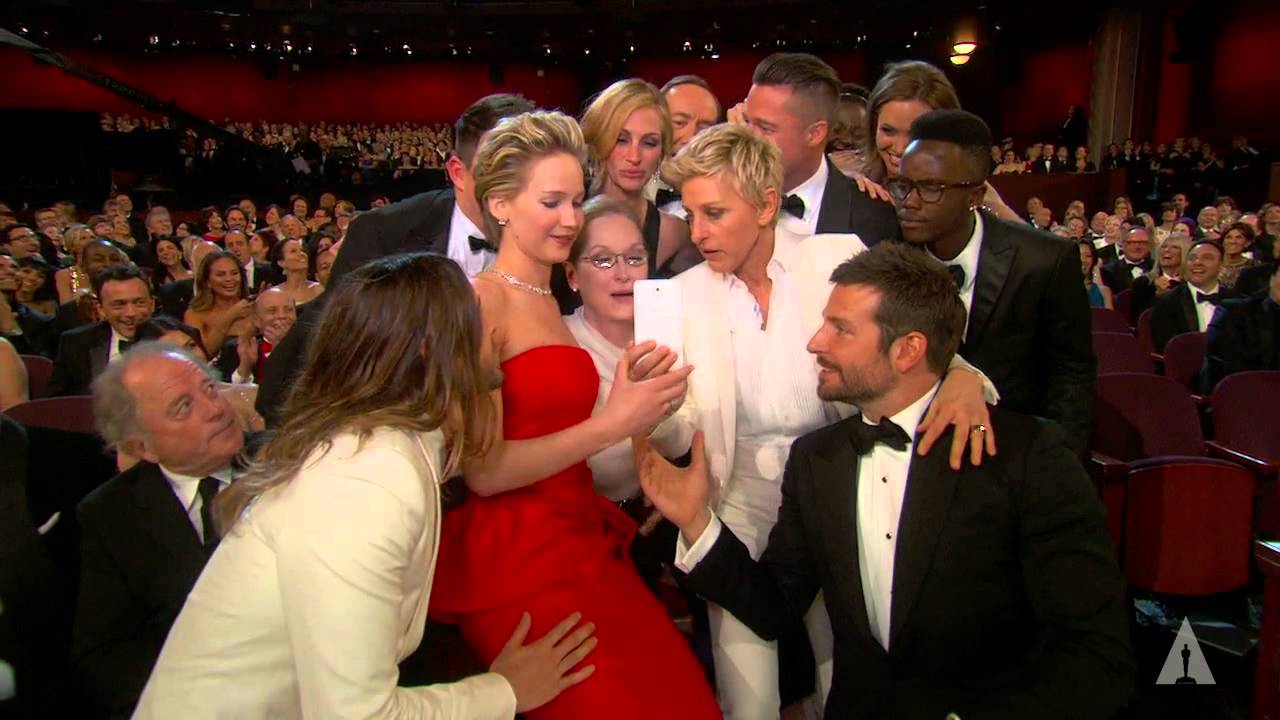
Congrats to Andrew Adashek, Grace Lee, Kate Bowen, Liz Myers, Lara Cohen and Fred Graver for making this moment happen on air. - 06
In-Product Second Screening
Today the term "second screening" is common. It's shorthand for how people look at their phones while watching a show. But 15 years ago, we pioneered show-specific interactive second screening by adding in new real-time experiences (voting on who wore it best!) and in-Tweet buy buttons (first launched for the World Cup, but that's another story).

Twitter second-screen voting experiences for the Oscars and red carpet. - 07
From the Oscars to the World
After the successful nights at the Grammys and the Oscars, we then placed a Twitter Mirror at nearly every major event for the next 10 years. We made special versions for the NBA All-Star Game, special versions for Bollywood, special hand-held versions (first designed for the ballet, later used on-court in the NBA), and more. We made fancy video versions and 360-cam versions, but the selfie is the format that had lasting power. The most important aspect, however, was the teamwork required to integrate it across engineering, media, comms, product, and design. If we had treated the project as a one-off marketing activation, it would have died after one event. It lasted so long, and was adapted to so many different moments, because it was designed as a cross-team, cross-product, fully integrated audience experience.
A 360-camera version of the Twitter Mirror on the red carpet.


